A9K-4T-L - Cisco ASR 9000 Series Line Card Overview
A9K-4T-L - Cisco ASR 9000 Series Line Card is a genuine edge and wide-area routing product from Cisco, a global name in networking whose platforms are used by enterprises, service providers and data-center operators alike. Belonging to the Cisco ASR 9000 Series family, the A9K-4T-L unit is built to the original factory specification, so it integrates with existing Cisco deployments predictably and behaves exactly as the platform documentation describes. In the network, it is deployed as a standalone unit or as part of a larger managed network, following the standard operating procedures of the platform.
This unit follows the original factory specification for the Cisco ASR 9000 Series family, covering its intended role without compatibility surprises. Standard mounting, cabling and management practices apply, and it interoperates with surrounding hardware using the same procedures as other Cisco equipment already deployed in the network.
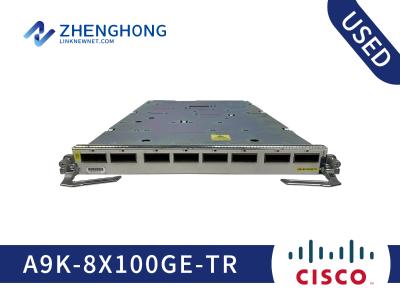
Typical deployments include branch and campus WAN connectivity, service-provider edge and MPLS deployments, and secure remote-site interconnect. Organizations commonly source it for refresh programs, capacity expansion and spares management, keeping a tested unit on hand so outages stay short and replacements are predictable. The factory detail for this unit reads: “Cisco ASR 9000 Line Card A9K-4T-L 4-Port 10GE Low Queue Line Card, Requires XFPs”. This makes it a practical choice when original-spec hardware is required at a predictable cost.
Every unit at LinkNewNet is inspected and tested before dispatch, and stock is graded, cleaned and verified for correct operation, including port status, console access and firmware state. Our warranty coverage and responsive technical support protect the purchase after it arrives, and our team can confirm revision levels and software compatibility before you order. For volume requirements we also offer configuration checks and staged delivery options.
Contact our sales team for current availability, lead time and shipping options for the A9K-4T-L. We respond quickly with stock status and a firm quote, so you can plan the refresh or expansion with confidence.
Key Specifications
Applications
Enterprise WAN
Branch and campus routing with advanced services.
Service Provider
Edge routing for ISP and MPLS deployments.
Data Center
Interconnect core and aggregation layers reliably.
Buying a Pre-Owned A9K-4T-L
Verify the unit is tested, firmware confirmed, and condition documented. Every unit is fully tested and warranty covered. Contact our team for current stock and availability.
A9K-4T-L Specification | |
Part Number | A9K-4T-L |
Product Description | 4-Port 10GE Low Queue Line Card, requires XFPs |
Total queues | 8 per port |
Policers | 8000 |
Ethernet flow points (EFPs) | 4000 |
Cisco IOS XR Software support | ● Modular software design: Cisco IOS XR Software demonstrates Cisco networking leadership in helping customers realize the power of their networks and the Internet. The software provides exceptional routing-system scalability, high availability, service isolation, and manageability to meet the mission-critical requirements of next-generation networks. ● Operating system infrastructure protection: Cisco IOS XR Software provides a microkernel architecture that forces all but the most critical functions, such as memory management and thread distribution, outside of the kernel. This setup prevents failures in applications, file systems, and even device drivers from causing widespread service disruption. ● Process and thread protection: Each process – even individual process threads – occurs in its own protected memory space, and communications between processes are accomplished through well-defined, secure, and version-controlled application programming interfaces (APIs). This setup significantly minimizes the effect that any process failure can have on other processes. ● Process restart: The line cards offer the ability to restart critical control-plane processes both manually and automatically in response to a process failure, rather than restarting the entire OS. This feature helps to support the Cisco IOS XR Software goal of continuous system availability and allows for quick recovery from process or protocol failures with minimal disruption to customers or traffic. ● State checkpointing: The line cards offer the capability to maintain a memory and critical operating state across process restarts so that routing adjacencies and signaling state can be maintained during an RSP switchover. |
L2VPN services | ● Virtual Private LAN Services (VPLS): These services are included in a class of VPN that supports the connection of multiple sites in a single bridged domain over a managed IP/MPLS network. VPLS presents an Ethernet interface to customers, simplifying the LAN and WAN boundary for service providers and customers, and supporting rapid and flexible service provisioning, because the service bandwidth is not tied to the physical interface. All services in a VPLS appear to be on the same LAN, regardless of location. ● Hierarchical VPLS (HVPLS): HVPLS provides a level of hierarchy at the edge of the VPLS network for increased scale. Two options of HVPLS are supported: QinQ access and Ethernet over MPLS (pseudowire) access. ● Virtual Private Wire Service (VPWS) with Ethernet over MPLS (EoMPLS): EoMPLS transports Ethernet frames across an MPLS core using pseudowires. Individual EFPs or traffic from an entire port can be transported over the MPLS backbone using pseudowires to an egress interface or subinterface. ● Pseudowire redundancy: Pseudowire redundancy supports the definition of a backup pseudowire to protect a primary pseudowire that fails. ● G.8032: G.8032 is a feature that provides the sub-50-ms protection for Ethernet traffic in a ring topology. The implementation on the Cisco ASR 9000 Series is compliant with version 2 of the ITU-T standard. ● Multisegment pseudowire stitching: Multisegment pseudowire stitching is a method for interworking two pseudowires together to form a cross-connect relationship. |
Multicast | ● IPv4 Multicast: The line cards support Internet Group Management Protocol Versions 2 and 3 (IGMPv2 and v3), Protocol Independent Multicast-Source Specific Multicast (PIM-SSM), PIM sparse mode (PIM-SM), PIM SSM Mapping, Multicast Source Discovery Protocol (MSDP), Multicast VPN, and Anycast rendezvous point (RP). ● IGMP v2 and v3 snooping: This Layer 2 mechanism efficiently tracks multicast membership on an L2VPN network. Individual IGMP joins are snooped at the VLAN level or pseudowire level and then results are summarized into a single upstream join message. In residential broadband deployments, this scenario allows the network to send only channels that are being watched to the downstream users. |
Layer 3 routing | ● IPv4 routing: Cisco IOS XR Software supports a wide range of IPv4 services and routing protocols, including Border Gateway Protocol (BGP), Intermediate System-to-Intermediate System (IS-IS), Open Shortest Path First (OSPF), Routing Information Protocol (RIP), static, IPv4 Multicast, Routing Policy Language (RPL), and Hot Standby Router Protocol (HSRP) and Virtual Router Redundancy Protocol (VRRP) features. ● IPv6 routing: Cisco IOS XR Software supports IPv6 services, including OSPFv3, IS-IS, Virtual Router Redundancy Protocol (VRRPv6), DHCPv6 relay, and static routing. ● BGP Prefix Independent Convergence (PIC): BGP PIC provides the ability to converge BGP routes using the fast-convergence innovation that is distinctive to Cisco IOS XR Software. |
MPLS Traffic Engineering (TE) | ● MPLS Traffic Engineering: Cisco IOS XR Software supports MPLS protocols, such as Traffic Engineering-Fast Reroute (TE-FRR), Resource Reservation Protocol (RSVP), Label Distribution Protocol (LDP), and Targeted Label Distribution Protocol (T-LDP). ● MPLS Traffic Engineering Preferred Path: Preferred tunnel path functions let you map pseudowires to specific traffic engineering tunnels. Attachment circuits are cross-connected to specific MPLS TE tunnel interfaces instead of remote provider-edge router IP addresses (reachable using Interior Gateway Protocol [IGP] or LDP). ● MPLS Traffic Engineering Auto-Bandwidth: MPLS TE automatic bandwidth adjustment provides the means to automatically adjust the bandwidth allocation for traffic engineering tunnels based on their measured traffic load. ● Point to Multipoint (P2MP) Traffic Engineering: The MPLS P2MP TE feature allows you to forward MPLS traffic from one source to multiple destinations. P2MP TE provides a single point of traffic control and the ability to configure explicit paths to optimize traffic distribution, while benefitting from extending FRR protection to P2MP TE sub-LSPs. |
High availability | ● MPLS TE-FRR: MPLS Traffic Engineering-FRR delivers Layer 3 protection switching for networks currently configured with MPLS LSP. MPLS TE-FRR provides temporary rerouting around a failed link, node, or path. ● Bidirectional Forwarding Detection (BFD): BFD is a detection protocol that is designed to provide fast-forwarding path-failure detection times for all media types, encapsulations, topologies, and routing protocols. ● 802.3ad Link Aggregation Bundles: The line cards support a bundle of multiple links to provide added resiliency and the ability to load-balance traffic over multiple member links. ● Multichassis Link Aggregation Group (MC-LAG): MC-LAG provides a standards-based 802.3ad bundle for a connecting device to reach a pair of Cisco ASR 9000 Series Aggregation Services Routers that appear as a single router to the connecting device. Rapid restoration times are possible even if there is a link or node failure, which improves the operational environment for the connecting device. MC-LAG can work with a long list of solutions on the Cisco ASR 9000 Series routers, such as business L2VPN and L3VPN, residential service backhaul, mobile aggregation, and service provider edge. |
Security | Cisco IOS XR Software: Cisco IOS XR Software provides comprehensive network security features, including access control lists (ACLs); control-plane protection; routing authentications; authentication, authorization, and accounting (AAA) and TACACS+; Secure Shell (SSH) Protocol; SNMPv3; and leading Routing Policy Language (RPL) support. Layer 2 ACLs: You can use this security feature to filter packets under an EVC based on MAC addresses. Layer 3 ACLs: This feature provides ACL matching by IPv4 packet attributes. Security: Many critical security features are supported: ● 802.1ad Layer 2 Control Protocol (L2CP) and bridge-protocol-data-unit (BPDU) filtering ● MAC limiting per EFP or bridge domain ● Unicast, multicast, and broadcast storm-control blocking on any interface or port ● Unknown Unicast Flood Blocking (UUFB) ● Dynamic Host Configuration Protocol (DHCP) snooping ● Unicast Reverse Path Forwarding (URPF) ● Control-plane security ● Dynamic ARP Inspection (DAI) ● IP Source Guard (IPSG) |
Connectivity | 10-Mbps, 100-Mbps, 1-Gbps, and 10-Gbps 802.3 Ethernet |
Memory | 4 GB DRAM |
Options | Each line card is available as either a low queue, base or extended line card. |
Physical dimensions (H x W x D); weight | 14 x 1.72 x 20.5 in.(35.56 x 4.37 x 52.07 cm) 14 – 19 lb (6.35 – 8.62 kg) |
Power | Maximum 350W – 630W (depending on the card type); typical 310W – 565W (depending on the card type) |
Operating altitude | –60 to 4000m (up to 2000m conforms to IEC, EN, UL, and CSA 60950 requirements) |
Network Equipment Building Standards (NEBS) | Cisco ASR 9000 Series is designed to meet: ● SR-3580: NEBS Criteria Levels (Level 3) ● GR-1089-CORE: NEBS EMC and Safety ● GR-63-CORE: NEBS Physical Protection ● VZ.TPR.9205: Verizon TEEER |
ETSI standards | Cisco ASR 9000 Series is designed to meet (qualification in progress): ● EN300 386: Telecommunications Network Equipment (EMC) ● ETSI 300 019 Storage Class 1.1 ● ETSI 300 019 Transportation Class 2.3 ● ETSI 300 019 Stationary Use Class 3.1 ● EN55022: Information Technology Equipment (Emissions) ● EN55024: Information Technology Equipment (Immunity) ● EN50082-1/EN-61000-6-1: Generic Immunity Standard |
EMC standards | Cisco ASR 9000 Series is designed to meet: ● FCC Class A ● ICES 003 Class A ● AS/NZS 3548 Class A ● CISPR 22 (EN55022) Class A ● VCCI Class A ● BSMI Class A ● IEC/EN 61000-3-2: Power Line Harmonics ● IEC/EN 61000-3-3: Voltage Fluctuations and Flicker ● EN 50121-4: Railway EMC |
Safety | Cisco ASR 9000 Series is designed to meet: ● UL/CSA/IEC/EN 60950-1 ● IEC/EN 60825 Laser Safety ● ACA TS001 ● AS/NZS 60950 ● FDA: Code of Federal Regulations Laser Safety |
A9K-4T-L - Product Notes
This listing is a specific SKU variant of the A9K-4T-L family. Review the specifications above and confirm compatibility with your existing infrastructure, including software version, mounting, and interface requirements, before ordering.
For volume requirements we offer configuration checks and staged delivery options. Our team can confirm revision levels, software compatibility, and lead time before you place an order.
Every unit at LinkNewNet is inspected and tested before dispatch, and stock is graded, cleaned and verified for correct operation.
A9K-4T-L - Product Notes
This listing is a specific SKU variant of the A9K-4T-L family. Review the specifications above and confirm compatibility with your existing infrastructure, including software version, mounting, and interface requirements, before ordering.
For volume requirements we offer configuration checks and staged delivery options. Our team can confirm revision levels, software compatibility, and lead time before you place an order.
Every unit at LinkNewNet is inspected and tested before dispatch, and stock is graded, cleaned and verified for correct operation.
A9K-4T-L - Product Notes
This listing is a specific SKU variant of the A9K-4T-L family. Review the specifications above and confirm compatibility with your existing infrastructure, including software version, mounting, and interface requirements, before ordering.
For volume requirements we offer configuration checks and staged delivery options. Our team can confirm revision levels, software compatibility, and lead time before you place an order.
Every unit at LinkNewNet is inspected and tested before dispatch, and stock is graded, cleaned and verified for correct operation.
A9K-4T-L - Cisco Series Notes
This listing is part of the Cisco enterprise networking product family, sourced and tested by LinkNewNet for enterprise deployment. Cisco router is positioned at the WAN edge, branch, or service-provider aggregation point. It provides routing, VPN, QoS and security services, and integrates with Cisco IOS-XE / IOS-XR management.
Deployment guidance: When planning this A9K-4T-L unit into a network, confirm the software image (IOS/IOS-XE/NX-OS) required, the power and cooling profile, and the upstream/downstream interface types that match your existing infrastructure. For a like-for-like refresh, match the feature set of the units already in service so management and automation behave consistently.
Our Cisco reconditioning process: Every pre-owned Cisco unit at LinkNewNet passes a documented reconditioning flow before dispatch - visual inspection, internal cleaning, firmware verification, port-by-port testing, and configuration reset to factory defaults. This ensures the unit you receive operates reliably and integrates cleanly with your existing Cisco management tools.
Related models in this family: ASR-9001, ASR-9904, A9K-24X10GE-SE, ASR-9903, ASR-9901. Compare specifications to confirm the right port density, feature set and uplink options for your deployment.
Model code: L = LAN Base feature set - this suffix indicates the feature set, power, or regulatory variant of the A9K-4T-L, which affects software licensing and regional compliance.